
The growth of the internet has created many opportunities for people to earn money online. Businesses are constantly searching for effective ways to promote their products and reach potential customers. At the same time, individuals are exploring digital platforms to build their careers and generate income. Affiliate marketing has become one of the popular methods that connects businesses, marketers, and customers through online promotion.
Affiliate marketing is a performance-based marketing strategy in which individuals promote products or services offered by other businesses and earn a commission when people complete specific actions through their referral links. These actions may include making a purchase, signing up for a service, or registering for a program. Unlike traditional business models, affiliate marketing does not usually require marketers to create their own products, maintain inventory, or manage product delivery.
With the right strategy, useful content, and consistent effort, affiliate marketing can become a valuable part of an online business or digital marketing career.
What Is Affiliate Marketing?
Affiliate marketing is a digital marketing method that allows individuals to earn commissions by recommending products or services to an audience. Affiliates receive a unique tracking link from a company or affiliate program. When someone clicks the link and completes the required action, the affiliate may receive a commission according to the program’s terms.
For example, a blogger who writes about technology may recommend a laptop through an affiliate link. If a reader purchases the laptop through that link, the blogger may earn a percentage of the sale. The company gains a potential customer, the reader discovers a relevant product, and the affiliate receives a commission.
This marketing approach benefits businesses because they can work with publishers, creators, and marketers who already have access to specific audiences. It also gives beginners an opportunity to learn online promotion without developing their own products.
How Does Affiliate Marketing Work?

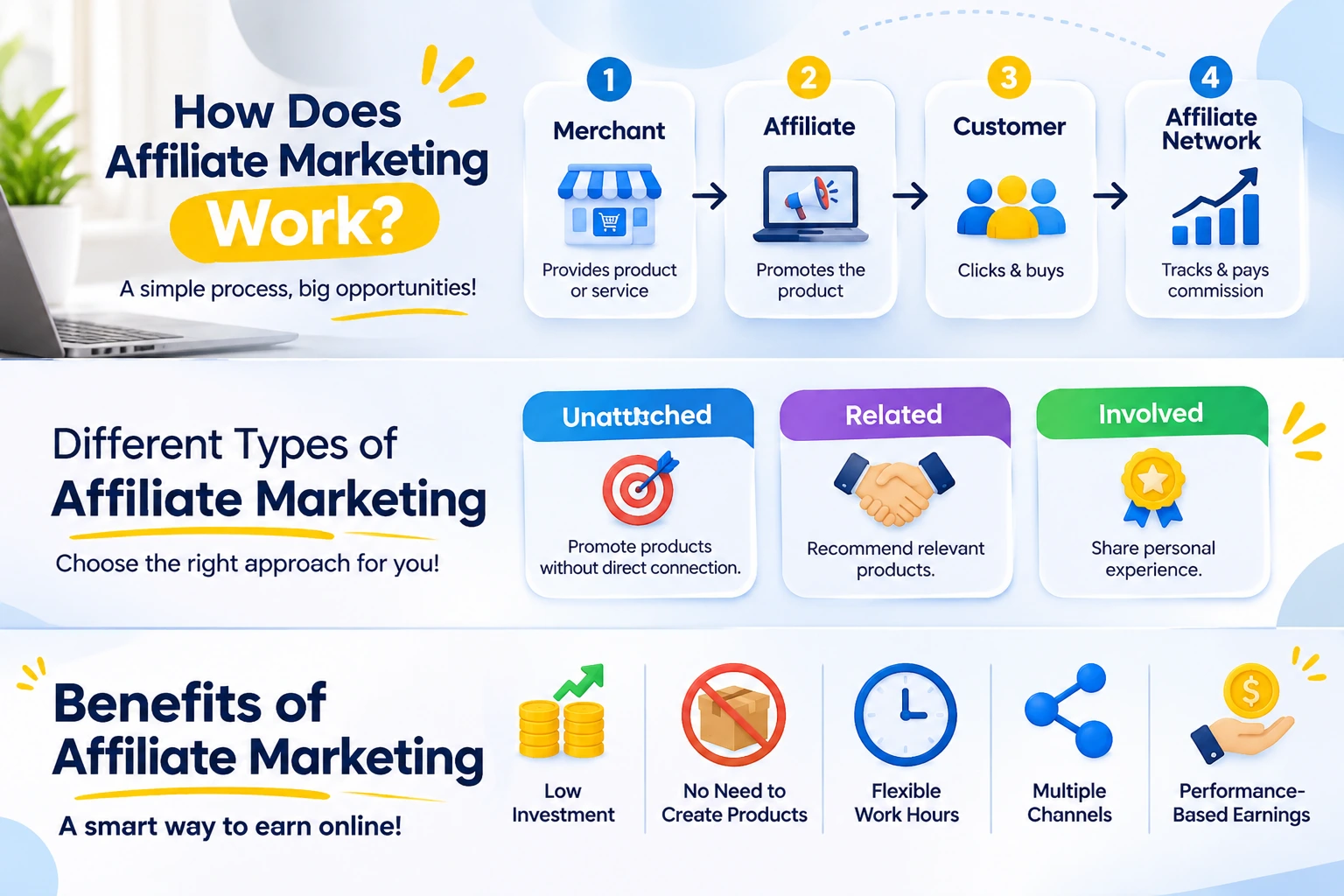
Affiliate marketing generally involves four main participants: the merchant, the affiliate, the customer, and the affiliate network or tracking platform.
- Merchant: The merchant is the business or individual that provides a product or service. It creates the offer and determines the commission structure.
- Affiliate: The affiliate promotes the merchant’s products through websites, blogs, social media accounts, videos, or email newsletters. The affiliate’s main responsibility is to connect relevant products with interested audiences.
- Customer: The person finds the recommendation, clicks the affiliate link to go to the store’s website, and buys something or does the required action.
4. Affiliate Network: An affiliate network may connect merchants with affiliates and provide tracking, reporting, payment management, and access to promotional offers. Some companies manage their affiliate programs independently instead.
The process usually begins when an affiliate joins a suitable program. After approval, the affiliate receives tracking links and promotional resources. Then, the affiliate makes content to introduce the product and explain why it’s great. When a customer completes a qualifying action through the link, the transaction is recorded and the affiliate may earn a commission.
Different Types of Affiliate Marketing
Affiliate marketing can be divided into different categories based on the relationship between the marketer and the product being promoted.
1. Unattached Affiliate Marketing
In unattached affiliate marketing, the promoter has little or no direct connection with the product’s niche. The affiliate may use advertising campaigns or other promotional methods to generate clicks and conversions. This approach can be useful for experienced marketers, but it may require a strong understanding of advertising costs, audience targeting, and campaign performance.
2. Related Affiliate Marketing
Related affiliate marketing involves promoting products connected to a person’s content or audience, even when the promoter has not personally used every product. For example, a fitness blogger might recommend exercise equipment that matches the interests of their readers. Marketers should carefully research these products and avoid making claims they cannot support.
3. Involved Affiliate Marketing
In involved affiliate marketing, the promoter has personal experience with the product or service. This allows the affiliate to share practical observations, explain advantages and disadvantages, and provide a more detailed recommendation. Honest product reviews can help audiences make informed purchasing decisions.
Benefits of Affiliate Marketing
Affiliate marketing offers several advantages for individuals and businesses when it is managed responsibly.
Low starting investment: Beginners can often start with a blog or an existing social media account. However, expenses may arise from website hosting, content creation, tools, or advertising.
No need to create products: Affiliates promote products developed by other businesses, allowing them to focus on content, audience research, and marketing.
Flexible working opportunities: Affiliate marketing can be managed alongside studies, employment, freelancing, or another online business. The schedule depends on the marketer’s goals and workload.
Multiple promotional channels: Affiliates can use search engines, blogs, YouTube, Instagram, email newsletters, and other suitable platforms to reach potential customers.
Performance-based earnings: Many programs reward affiliates for measurable results, such as qualifying sales or leads. Earnings depend on commission rates, conversion rates, traffic quality, and program conditions.
Opportunity to develop digital skills: Affiliate marketing helps people improve their knowledge of search engine optimization, content marketing, social media strategy, analytics, and audience behavior.
Although these benefits make affiliate marketing attractive, it does not guarantee quick profits. Building a reliable source of income requires patience, testing, and consistent improvement.
How to Start Affiliate Marketing
Starting affiliate marketing becomes easier when the process is divided into clear steps.
Step 1: Choose a Suitable Niche
A niche is a specific subject or market that you want to focus on. Examples include technology, beauty, education, fitness, travel, home improvement, and digital marketing.
Choose a niche that combines audience demand, your interests, and suitable products. A focused niche helps you create relevant content and build trust with people who share similar interests.
Step 2: Research Affiliate Programs
After selecting a niche, identify businesses that offer affiliate partnerships.Analyze their commission rates, payout terms, cookie windows, product standards, approval criteria, and promotional guidelines.
Popular examples include Amazon Associates, the affiliate programs offered by individual software companies, and selected affiliate networks. Program availability and eligibility requirements can vary by country and may change over time.
Before joining a program, check whether its products genuinely match your audience’s needs.
Step 3: Select a Marketing Platform
Check how much they pay, when you get your money, how long tracking cookies last, if their products are good, and what their rules are.
Starting with one or two channels can make it easier to maintain quality and measure results.
Step 4: Create Valuable Content
Content serves as the cornerstone of any successful affiliate marketing strategy. Instead of repeatedly sharing promotional links, create useful resources that help people understand a product before purchasing it.
Examples include product comparisons, tutorials, detailed reviews, buying guides, frequently asked questions, and practical demonstrations. Good content should answer real questions, explain limitations, and provide information that supports purchasing decisions.
Step 5: Add Affiliate Links Transparently
Once approved, place your affiliate links naturally within relevant content. Explain why a product may be useful and provide enough information for readers to decide whether it suits their needs.
Clearly state that you have an affiliate link right next to where you recommend the product. Transparency helps readers understand that you may earn a commission when they purchase through your links.
Step 6: Track Performance and Improve
Use available analytics and affiliate dashboards to measure clicks, conversions, commission earnings, and the performance of individual content pieces. These insights can help identify which topics attract interested visitors and which pages need improvement.
Regularly update outdated information, improve weak content, and test different calls to action without misleading your audience.
The Role of SEO in Affiliate Marketing
Search engine optimization (SEO) can help affiliate websites attract visitors who are actively searching for information about products or services. Instead of relying entirely on paid advertising, affiliates can create useful pages that answer specific search queries.
Keyword research helps identify what potential customers want to know. For example, a technology website might target phrases such as “best budget smartphones,” “laptop comparison,” or “how to choose a laptop for students.”
On-page SEO includes writing descriptive titles, organizing content with clear headings, creating useful meta descriptions, optimizing images, and linking related pages. Technical SEO also matters because website speed, mobile usability, crawlability, and indexability can affect how search engines access and understand a website.
However, ranking in search results is not guaranteed. Affiliates should prioritize original insights, helpful comparisons, accurate information, and a positive user experience rather than publishing large amounts of repetitive content.
Common Affiliate Marketing Mistakes
Many beginners struggle because they focus on earning commissions before understanding their audience. A common mistake is promoting too many things that have nothing to do with each other. This can make a website or social media account appear unfocused and reduce audience trust.
Another mistake is picking products just because they pay the most money. A high commission does not necessarily mean that a product is valuable or suitable for the intended audience.
Some affiliates also rely on copied content, exaggerated claims, excessive promotional links, or unrealistic income expectations. These practices can damage credibility and may violate platform or program rules.
A better approach is to research products carefully, explain their limitations, create original content, disclose affiliate relationships, and build a consistent publishing schedule. Affiliates should also review program policies regularly and avoid misleading advertising techniques.
Is Affiliate Marketing Suitable for Beginners?
Affiliate marketing can be a suitable starting point for people interested in digital marketing, content creation, and online business. Beginners can start by learning one niche, selecting a platform, researching affiliate programs, and publishing helpful content.
For example, someone learning digital marketing could create a blog about SEO tools and explain how different tools support keyword research, website audits, or content optimization. Relevant affiliate offers can be integrated where they authentically provide value to readers.
The most important skills include communication, research, SEO, content writing, social media marketing, and performance analysis. Developing these skills takes time, and income may be limited or absent during the early stages.
Rather than expecting immediate results, beginners should focus on helping their audience, improving content quality, and learning from measurable performance.
Conclusion
Affiliate marketing has created new opportunities for individuals to participate in the digital economy without developing their own products. By promoting relevant products through useful content, marketers can connect businesses with potential customers and earn commissions from qualifying actions.
Success depends on choosing an appropriate niche, researching trustworthy affiliate programs, creating valuable content, applying effective SEO techniques, and understanding audience needs. Transparency, patience, and ongoing education are vital for a sustainable affiliate strategy.
For beginners, the best way to move forward is to start with a clear plan, select products carefully, and focus on providing genuine value. Affiliate marketing is not a guaranteed source of income, but a thoughtful and consistent approach can help develop practical digital marketing skills and create opportunities for long-term growth.
Author:https://marketingbyfahima.com/